

An amine catalyst is a type of chemical catalyst that contains one or more amine groups (nitrogen atoms with lone pair of electrons) on its molecular structure. Amines can act as both a base and a nucleophile, thus they can help to accelerate chemical reactions by increasing the rate of bond formation or breaking in a reaction. Amine catalysts are widely used in the production of plastics, resins, adhesives, coatings, and other industrial applications where fast cure time or high rate of reaction is desired. Examples of amine catalysts include triethylenediamine (TEDA), dimethylaminopropylamine (DMAPA), and diethylenetriamine (DETA).
Advantages of Amine Catalyst
High efficiency
Amine catalysts are highly reactive and have a high catalytic efficiency. They can activate multiple bonds at the same time, leading to faster reaction rates and increased yield.
Mild Reaction Conditions
Many amine catalysts can activate reactions at mild temperatures and pressures, which is beneficial for reducing energy costs and minimizing unwanted side reactions.
Low Toxicity
Some amine catalysts are non-toxic and environmentally friendly, which is important for reducing the impact of chemical reactions on the environment.
Catalytic flexibility
Amine catalysts are versatile and can be used in a wide range of reactions such as transesterification, Michael addition, and aldol reactions.
Selectivity
Amine catalysts can selectively catalyze specific reactions without interfering with other functional groups in the reaction mixture.
Ease of use
Amine catalysts are usually easy to handle and store, making them widely accessible to researchers and industrial manufacturers alike.
-
![MXC-TEDA]()
-
![MXC-A33]()
-
![MXC-8]()
-
![MXC-5]()
-
![MXC-BDMAEE]() MXC-BDMAEEName: BIS(2-DIMETHYLAMINOETHYL) ETHER(A-1). Cas no.: 3033-62-3. Purity: ≥99%. Appearance: Clear, Colorless to light yellow Liquidread more
MXC-BDMAEEName: BIS(2-DIMETHYLAMINOETHYL) ETHER(A-1). Cas no.: 3033-62-3. Purity: ≥99%. Appearance: Clear, Colorless to light yellow Liquidread more -
![MXC-41]()
-
![MXC-T]()
-
![MXC-C15]()
-
![MXC-TMA]()
-
![MXC-37]()
-
![MXC-DMEA]()
-
![MXC-DPA]()


Why choose us?
Experience
With more than 10 years of industry experience, we have an in-depth understanding of the field of polyurethane catalysts. Our expertise allows us to develop innovative solutions that meet our customers' specific requirements. We have successfully served various industries including construction, furniture, shoe sole, automotive, coatings, etc.
Product
Our comprehensive product range addresses different applications and customer needs. We offer a variety of catalysts that enhance the performance and characteristics of polyurethane products. These include amine-based catalysts, metal-based catalysts and specialty catalysts customized for specific applications. Our products are continually reviewed and improved to ensure optimal results and compliance with industry standards.
Team
Our talented and dedicated team is instrumental in driving our company's success. We have a team of experienced chemists and engineers who are passionate about their work. Their expertise coupled with their commitment to continuous learning and innovation enables us to provide our customers with cutting-edge products and tailor-made solutions.
Quality
We have established a strict quality management system to manage every aspect of our operations, from raw material procurement to product manufacturing and delivery. We adhere to the highest quality standards and use advanced testing methods to ensure our catalysts meet all relevant specifications, including purity, reactivity and stability. Our commitment to quality doesn't end with our products, as we also prioritize excellent customer service and timely delivery.
Common Types of Amine Catalyst

Primary Amines
Secondary Amines
Tertiary Amines
Aliphatic Amines
Aromatic Amines
Chiral Amines
Quaternary Ammonium Salts
Amine catalysts are extensively used in various industries, including the production of polyurethane foams, coatings, adhesives, and sealants. They are also used in the preparation of pharmaceuticals, dyes, and agrochemicals. Here are some specific applications of amine catalysts:
●Polyurethane foams: Amine catalysts are used in the production of polyurethane foams, which are widely used in construction, furniture, and automotive industries.
●Coatings: Amine catalysts are used as curing agents in epoxy coatings to improve their hardness, flexibility, and chemical resistance.
●Adhesives and sealants: Amine catalysts are used as crosslinking agents in the manufacturing of adhesives and sealants.
●Pharmaceuticals: Amines are used as catalysts in the preparation of pharmaceuticals, such as antibiotics, anti-inflammatory drugs, and antacids.
●Dyes: Amines are used as catalysts in the production of dyes, which are widely used in the textile industry.
●Agrochemicals: Amines are used as catalysts in the production of pesticides, herbicides, and fertilizers.
Amine catalysts are versatile and play crucial roles in various industrial processes. They help in the synthesis of diverse chemicals and materials, making them important for the economy and society.
Effect of Catalysts
The effect of a catalyst is that it lowers the activation energy for a reaction.
Generally, this happens because the catalyst changes the way the reaction happens (the mechanism). We can visualize this for a simple reaction coordinate in the following way.
In a more generally sense, the catalyzed reaction may have a number of new barriers and intermediates. However, the highest barrier will now be significantly lower than the previous largest barrier. For example, below is an example of the reaction path that shows a catalyzed and an uncatalyzed reaction. The path with the catalyst now has two steps along with an intermediate species. However, the barriers for both steps are much much lower than in the uncatalyzed reaction.
A catalyst is a substance that speeds up the rate of a chemical reaction but is not consumed during the course of the reaction. A catalyst will appear in the steps of a reaction mechanism, but it will not appear in the overall chemical reaction (as it is not a reactant or product). Generally, catalysts alter the mechanism of the reaction in a substantial way such that the new barriers along the reaction coordinate are significantly lower. By lowering the activation energy, the rate constant is greatly increased (at the same temperature) relative to the uncatalyzed reaction.
There are many types of catalysts in the world. Many reactions are catalyzed at the surface of metals. In biochemistry, enormous numbers of reactions are catalyzed by enzymes. Catalysts can either be in the same phase as the chemical reactants or in a distinct phase.
Catalysts in the same phase are called homogeneous catalysts, while those in different phases are called heterogeneous catalysts.
Organic Catalyst Boasts Big Benefits
An enzyme-mimicking catalyst opens a new route to important organic molecules such as glycolic acid and amino acids from pyruvate, report researchers in Japan. Moreover, the new catalyst is cheaper, more stable, safer and more environmentally friendly than conventional metal catalysts used in industry, they note, adding that it also displays the high enantioselectivity required by the pharmaceutical industry.
“On top of these advantages, our newly developed organic catalyst system also promotes reactions using pyruvate that aren't easily achievable using metal catalysts,” says Santanu Mondal, a PhD candidate in the chemistry and chemical bioengineering unit at Okinawa Institute of Science and Technology (OIST) Graduate University, Okinawa, Japan, and lead author of a study recently published in Organic Letters.
“Organic catalysts, in particular, are set to revolutionize the industry and make chemistry more sustainable,” he stresses.
The researchers use an acid and an amine mixture to force the pyruvate to act as an electron donor rather than its usual role as an electron receiver.
Effectively mimicking how enzymes work, the amine binds to the pyruvate to make an intermediate molecule. The organic acid then covers up part of the intermediate molecule while leaving another part that can donate electrons free to react to form a new product.
Currently, the organic catalyst system only works when reacting pyruvate with a specific class of organic molecule called cyclic imines.
So, the researchers now are looking to develop a more-universal catalyst, i.e., one that can speed up reactions between pyruvate and a broad range of organic molecules.
The challenge here is to try to make the electron-donating intermediate stage of pyruvate react with other functional groups such as aldehydes and ketones. However, different catalysts create different intermediates, all with different properties. For example, the enamine intermediate created by the researchers' new reaction only reacts with cyclic imines. Their hypothesis, currently being investigated, is that creation of other intermediates such as an enolate, if possible, would achieve a broader pyruvate reactivity.
In terms of cost, the researchers note that a palladium catalyst used in similar reactions is 25 times more expensive than their organic acid - which also is made from eco-friendly quinine.
In addition, they believe scale-up of the process for industrial use definitely is possible. However, the researchers caution that the current amine-to-acid-catalyst loading ratio of 1:2 probably would need to be optimized for better results at a larger scale.
What is Catalysis?


Catalysts speed up a chemical reaction by lowering the amount of energy you need to get one going. Catalysis is the backbone of many industrial processes, which use chemical reactions to turn raw materials into useful products. Catalysts are integral in making plastics and many other manufactured items.
Even the human body runs on catalysts. Many proteins in your body are actually catalysts called enzymes, which do everything from creating signals that move your limbs to helping digest your food. They are truly a fundamental part of life.
Small Things Can Have Big Results.
In most cases, you need just a tiny amount of a catalyst to make a difference. Even the size of the catalyst particle can change the way a reaction runs. Last year, an Argonne team including materials scientist Larry Curtiss found that one silver catalyst is better at its task when it's in nanoparticles just a few atoms wide. (The catalyst turns propylene into propylene oxides, which is the first step in making antifreeze and other products.)
It Can Make Things Greener.
Industrial manufacturing processes for plastic and other essential items often produce nasty by-products which can pose hazards to human health and the environment. Better catalysts can help solve that problem. For example, the same silver catalyst actually produces fewer toxic by-products - making the whole reaction more environmentally friendly.
At its heart, a catalyst is a way to save energy. And applying catalysts on a grand scale could save the world a lot of energy. Three percent of all of the energy used in the U.S. every year goes into converting ethane and propane into alkenes, which are used to make plastics, among other things. That's the equivalent of more than 500 million barrels of gasoline.
Catalysts are also the key to unlocking biofuels. All biomass - corn, switchgrass, trees-contains a tough compound called cellulose, which has to be broken down to make fuel. Finding the perfect catalyst to disintegrate cellulose would make biofuels cheaper and more viable as a renewable energy source.
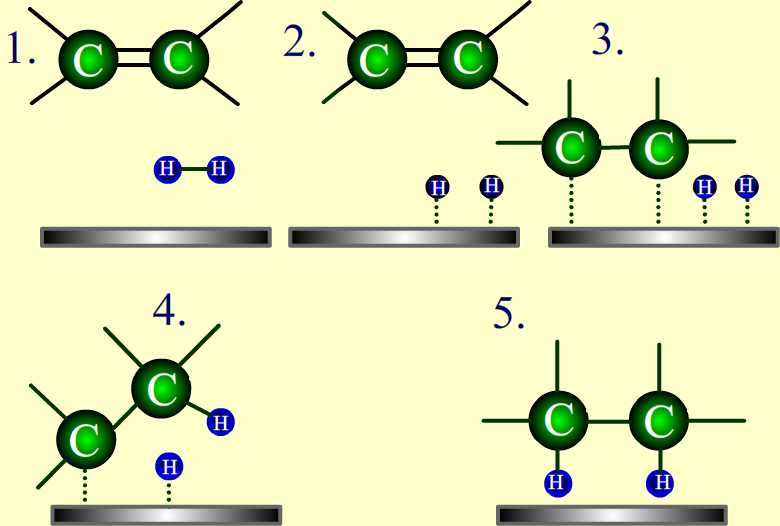
Many catalysts work in the same way. They provide a means for the reactant molecules to break bonds and then form temporary bonds with the catalyst. This means the catalyst must be somewhat reactive, but not too reactive (since we don't want these bonds to be permanent). For example, Pt metal serves as a catalyst for many reactions involving hydrogen gas or oxygen gas. This is because the Pt surface allows the H2 or O2 to break their bonds then form atomic species that are "bonded" to the Pt. However, these new bonds can be weak enough that the atomic species can then react with other molecules and leave the surface. In this way, the Pt metal returns to its pristine state after the reaction.
For example, the cartoon below depicts the reaction of ethene and hydrogen gas. The hydrogen lands on the surface and breaks its bond to form H atoms bonded to the surface . The double bond of the ethene is also broken and the two carbon atoms also bond to the surface . Then the H atoms can migrate until they collide with the bound carbon species and react to form ethane which can then leave the surface .
Is this how all catalysts work? No. The possibilities for how a catalysts actually works are endless. Some catalysts actually change during the course of the chemical reaction, but then are returned to their original state at the end of the reaction. For example, MnO2 catalyzes the decomposition of H2O2 to water and oxygen gas by the following mechanism.
So in the net reaction there is no change in MnO2. However, during the reaction it is converted into Mn2+ as well as Mn(OH)2.A catalyst can be identified this way in a reaction mechanism as it appears in the "reactants" initially but then is reformed later in the reaction.
Catalysts can also function by "holding" molecules in particular configurations while simultaneously weakening some particular bonds. This allows the catalyst to essentially "help" the chemistry by arranging the reacts in favorable geoemetries as well as by weakening bonds that need to break along the reaction coordinate.
The Role of Catalysis in Sustainable Chemistry
Though sustainability may feel like a recent buzzword, sustainable environmental practices have been firmly on the agenda since the publication of the United Nation's (UN's) ‘Our Common Future' in 1987. This groundbreaking report mapped out guiding principles for sustainable development as it is generally understood today, defining the concept as “development that meets the needs of the present without compromising the ability of future generations to meet their own needs.” This definition sums up the importance of implementing sustainability into all manufactured products.
The increasing emphasis on sustainability has sparked a transformative movement towards sustainable chemistry or 'green' chemistry , revolutionizing the way we design products and processes. This innovative approach seeks to enhance the efficiency of utilizing natural resources in chemical production. Three crucial avenues are pursued to achieve this goal: minimizing energy consumption, embracing environmentally friendly chemicals, and effectively managing material life cycles. Through these methods, sustainable chemistry is paving the way for a greener and more resource-efficient future.
Catalysts play a pivotal role in our pursuit of sustainable practices, offering a valuable tool to facilitate goals. They have contributed to the creation of biodegradable plastics, reducing our reliance on harmful materials. Furthermore, catalysts are instrumental in the production of fuels and fertilizers, optimizing efficiency and minimizing waste. Harnessing the power of catalysis empowers us to achieve remarkable feats in various fields while embracing sustainability as a guiding principle.
Polyurethane Amine Catalysts: Safe Handling Guidelines
Polyurethanes are generally made by reacting a diisocyanate, such as toluene diisocyanate (TDI) or methylene diphenyl diisocyanate (MDI), and a blended polyol. When a polyurethane foam is desired, the process uses additional chemicals, such as amine and/or metallic salt catalysts, auxiliary blowing agents, and silicone surfactants, to achieve the desired properties.
Amine catalysts are used to control and/or balance both the gelling reaction and the gas-forming or foaming reaction responsible for foam formation. Although several organometallic compounds or salts may be used as catalysts in the production of polyurethanes, many polyurethane manufacturers use either tertiary aliphatic amines or alkanolamines. Amine catalysts are typically 0.1 to 5.0 percent of a polyurethane formulation.
The commonly used catalysts in the synthesis of polyurethane and its raw materials mainly include amine catalysts and organometallic compounds. There are many varieties of amines and organometallic compounds. Taking into account various factors, there are only more than 20 types of polyurethane catalysts that are most commonly used.
One of the polyurethane catalyst types: Amine catalyst
Amine catalysts are generally used in the production of polyurethane foam and are mainly divided into the following categories:
(1)Aliphatic amine catalysts include N,N-dimethylcyclohexylamine, bis(2-dimethylaminoethyl)ether, N,N,N',N'-tetramethylalkylene diamine, Triethylamine, N,N-dimethylbenzylamine, etc.
(2) Alicyclic amine catalysts include solid amine, N-ethylmorpholine, N-methylmorpholine, N,N'-diethylpiperazine, etc.
(3) Alcohol compound catalysts include triethanolamine, DMEA, etc.
(4) Aromatic amines include pyridine, N,N'-lutidine and the like.
One of the polyurethane catalyst types: organo-metallic catalyst
Among the formulas of polyurethane elastomers, adhesives, coatings, sealants, waterproof coatings, paving materials, etc., organic metal catalysts such as dibutyltin dilaurate (DY-12) are the most commonly used, which can promote the reaction of isocyanate groups and hydroxyl groups effectively. But polyurethane catalysts can also accelerate the reaction between water and isocyanate in formulas with moisture. And special catalysts such as organic lead can be used in formulas such as plastic tracks.
Organometallic compounds include carboxylates, metal alkyl compounds, etc. The main metal elements contained in them are tin, potassium, lead, mercury, zinc, etc., and organotin compounds are the most commonly used.
The polyurethane catalyst is one of the most important additives for polyurethane foam. Different foam systems require different foaming and gel balances. In the production of polyurethane foam, catalysts play an important role. We strictly implement the batch inspection system, which is divided into raw material warehouse batch inspection and finished product storage batch inspection and production. Whether it is raw materials or finished products, we test every batch of products to ensure quality!
Our Factory
We have stable and superior route of synthesis, strict quality control and quality assurance system, experienced and responsible team, efficient and safe logistics. Based on this, our products are well recognized by the customers in Europe, Americas, Asia, Middle East etc.


FAQ
As one of the leading amine catalyst manufacturers and suppliers in China, we warmly welcome you to buy high quality amine catalyst made in China here from our factory. All chemicals are with high quality and competitive price.
Pmdeta Catalyst, 33lv Catalyst, amine catalyst for catalytic analgesic compound synthesis-
![MXC-TEDA]()
-
![MXC-A33]()
-
![MXC-8]()
-
![MXC-5]()
-
![MXC-BDMAEE]() MXC-BDMAEEName: BIS(2-DIMETHYLAMINOETHYL) ETHER(A-1). Cas no.: 3033-62-3. Purity: ≥99%. Appearance: Clear, Colorless to lightread more
MXC-BDMAEEName: BIS(2-DIMETHYLAMINOETHYL) ETHER(A-1). Cas no.: 3033-62-3. Purity: ≥99%. Appearance: Clear, Colorless to lightread more -
![MXC-41]()


